
Rachael DavisPress Association

 Collect/PA Real Life
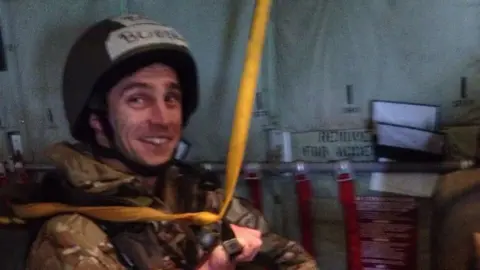
An RAF veteran has said his life changed forever after he fell nearly 1,000ft (304m) during a training session which went wrong.
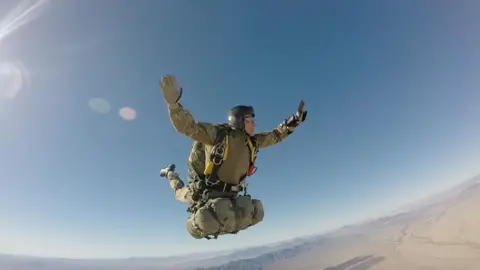
Rob Bugden, 40, jumped from a plane at 5,000ft (1,524m) in January 2016 as part of a parachuting exercise, when he collided mid-air with his teammate.
The next thing he remembers is waking up in hospital to discover that the collision had caused him to plummet to the ground, and left him paralysed from the neck down.
“I have absolutely no memory of it, and you know what? I’m alright with that,” said Rob, speaking 10 years after the accident.
Rob, from the Vale of Glamorgan, joined the RAF in 2008 as a physical training instructor, before deciding to specialise as a parachute jumping instructor in 2015.
The following year, he took part in a training jump in formation with six other parachutists.
“That day, I walked down the aircraft – it’s the last time I’m ever going to walk, which is really weird when you think about it,” he said.
 Collect/PA Real Life
He said the jump initially went “really well” – “[but] then I woke up in a hospital in Phoenix, Arizona”.
Rob was told that during the dive, while in the sky at about 1,000ft, there was a collision.
“That collision breaks my neck,” he said.
“The canopies collapse, and we fall roughly about 900ft. Fortunately for us, we landed on sand, and I, unfortunately, came off second best.”
The other man involved in the collision was Rob’s friend.
While Rob was knocked unconscious – “which is quite lucky in lots of ways, probably may well have saved my life” – his friend remained conscious but broke his tibia and fibula and tore his kidney.
“But more than that, he remembers everything,” Rob said.
He added there were some “very talented gentlemen on the ground”, including UK special forces who were doing an exercise in the same place.
After witnessing the collision, they went to help straight away.
“Without them, I don’t think I’d be alive,” Rob reflected.
“So thank you to all of them. It seems such a frivolous word, but yeah, what else can I say?”
 RAF Benevolent Fund/PA Real Life
Rob had several operations in the US including a tracheostomy, as he could not breathe by himself, a peg in his stomach to feed him, and a pacemaker fitted.
He also had his eye socket put back together, and fixations in his neck.
By this point Rob was completely paralysed but “in and out of consciousness all the time” due to heavy medication, so does not remember “a great deal”.
After around three weeks, he was brought back to the UK and admitted to the Queen Elizabeth Hospital in Birmingham, where “the long journey began”.
It was here that Rob said the reality hit him that he “couldn’t move”.
“We were a bit of a mess,” said Rob.
He learned his spinal cord had been severely crushed and that he was quadriplegic.
“Basically, all four of my limbs don’t work,” he explained.
It took Rob a long time to get his head around how different his life would be.
But he added: “I’m very stubborn. I think I’m always right, but actually, flipping that on its head, it also meant that I was not going to give up.”
Eventually, Rob was able to breathe by himself and then started getting some movement back in his shoulders. After a year he could feed himself.
“Even then, I was getting most on my T-shirt, but it didn’t matter, because I was doing it myself,” he said.
The next step was limiting the amount of help he needed for things such as using the toilet, and after two years he was able to flip his catheter himself, which felt like a big step.
‘So thankful, so grateful’
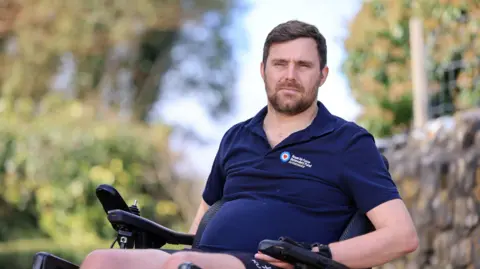
Today, Rob requires round-the-clock live-in care, but he is able to take part in hobbies such as going to the gym, hanging out with his dog Denzel, and going to the pub with his friends.
Rob affectionately calls Denzel his “lack of assistance dog, because he is useless”.
“If there’s chicken around, that’s it. He’s not going to listen,” he laughed.
“But actually, I’m completely and utterly lost without him. He’s my best friend. He is my companion, he’s my protector. He’s allowed me to make new friends and get out and about.”
During his long recovery and beyond, Rob received support from the RAF Benevolent Fund, a charity which supports serving and former RAF personnel and their families.
Rob had just bought his first flat before his accident but was not able to return there as he needed a specialised, adapted home, so the fund’s housing trust bought and adapted a home for Rob.
“I’ve got full access to the house with wet rooms, I’ve got two hoists – one in my bedroom, one in my living room, so I can get on my sofa. And I live next door to a pub, which is very handy,” he said.
Rob has left the RAF and adapted to a completely different way of life, but said he was “so thankful, so grateful” to have a wonderful group of friends and family rallying around him to make sure he is never alone.